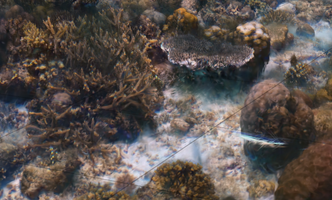
Current project to render stunning photogrammetry of coral reefs and empowers scientists with spatial AI tools for restoration and awareness efforts. Uses cutting-edge gaussian splat rendering approaches combined with LLM integration and embodied interface design. Prototypes run on Apple Vision Pro, and desktop devices, demo on request. Collaborative project across the Coastal Climate Resilience Center, HCI Researchers, and Wildflow.ai.
I’m a researcher on a multi-year Sloan Foundation funded project to explore multi-user VR interfaces for scientific sensemaking. I collaborate with scientists to investigate how XR can enhance data engagement in fields like wildfire mitigation and marine science. Our prototyping involves custom data visualization, interface, and networking code, alongside co-design and HCI validation techniques. Demos on request.
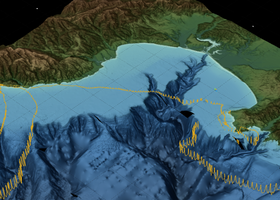
An XR system for wildfire resilience that uses AI to support situational awareness and community decision-making in high-risk environments. Built with multi-user spatial interfaces and real geospatial data, enabling first responders and researchers to collaboratively analyze fire behavior and evacuation planning. Presented at MXR 2026.
A collaborative WebXR viewer for the massive RYR1 protein, built for the Logitech Dev Studio 2026 competition. Uses the MX Ink stylus to let researchers tap individual amino acid residues in shared VR and inspect binding pocket metadata — residue number, chain, charge, polarity, size. Built on Three.js and Brahma.js with custom rendering techniques for bioinformatics data at scale.
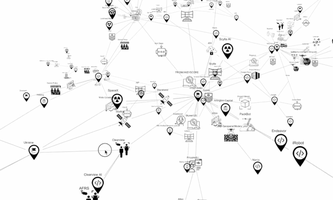
AI War Cloud is an award-winning Ars Electronica piece by Sarah Ciston that illustrates the complex relations of AI technology across organizations in industry and government. For exhibition, I created custom XR views for the immersive view, room-sized 3D view of a force directed graph using a bespoke rendering technique.
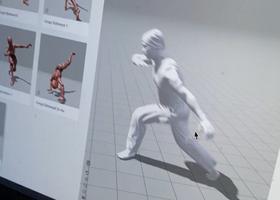
What does it mean to do spin, dance, and flip inside VR? This exploration tests AI pipelines for translating real motion into 3D embodiment. Prototype one uses photogrammetry for body capture, Mixamo auto-rigging, and capoeira animation retargeting. Prototype two employs Move.ai to motion-capture salsa sequences and animate a 3D avatar.
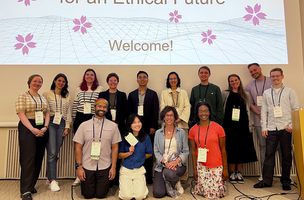
At this CHI '25 Workshop, participants engaged in deeper discussions, experienced demos, and shared practices around HCI research and XR addressing social challenges.
Applicants were from many backgrounds such as academia, industry, and creative, and wrote thoughtful papers and brought demos of in-progress, recent, or prior work.
For PhysioCHI '24, our team explored how passthrough head mounted displays could let us use physiological signals to enhance collocated movements. We wrote about how these interfaces may change for one-to-one, one-to-many, and mutual training circumstances.
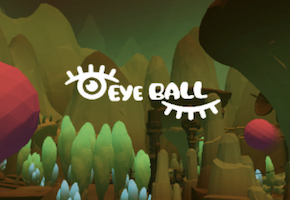
Eye Ball is a research project led to explore how gaze tracking can be used for novel interfaces in immersive multiplayer games. We tested how gaze interactions could augment VR dodgeball-- for example, if you closed your eyes, a shield would pop up to protect you!
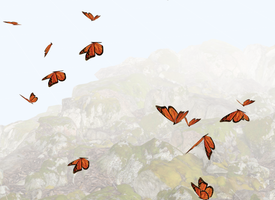
How do you prototype a novel hand-tracking interface across VR devices? This charming prototype captures the feeling of having a butterfly land on your hand. The widely accessible WebXR prototype serves as an example of accomadating the ambient motion of the body in an interface, and helps me demonstrate contemporary shader techniques and basics of environment design for comfort.
Chem Reality was a WebXR demo created at Vision Dev Camp 2024 that allows a user to browse 3D structures of molecules from an Apple Vision Pro and Meta Quest 3. An early test of three.js based project potential at the largest AVP developer gathering to date!
While Angie Fan was at the SET Lab, I was able to assist with an Applied Cuteness Research DIS paper and with some VR development for Cutie, an MFA thesis exhibition.
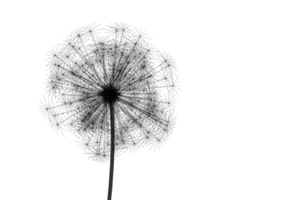
An interactive generative art piece where you blow into your mic to blow on a dandelion to make a wish. Every dandelion is unique! A charming, mobile-friendly, interaction design.
With the Processing Foundation I learned how to commit open source code and made contributions to p5xr a library that implements the WebXR standard and helps to view p5 3D sketches from VR headsets.
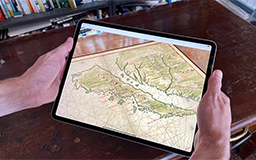
Booksnake lets you explore digitized archival items in the real world using the International Image Interoperability Framework (IIIF). This open framework, used by leading galleries, libraries, and museums, allows Booksnake to download an item's image and metadata, creating a custom virtual object for you to explore.
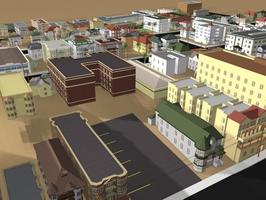
Bunker Hill VR is a VR recreation of 1930s Downtown LA by the Ahmanson Lab. Architectural and humanities scholars created 3D assets from historical photographs and schematics to create web, desktop, and VR apps. We collaborated with many institutions such as the Los Angeles City Archives, the Natural History Museum of Los Angeles, the Library of Congress, the Getty, and the Huntington Library.
Breath Garden 2021
Breath Garden was a WebXR based immersive environment linked to breathing exercises integrated with a BCI platform. It was built for the 2021 XR Brain Jam. The flow of a river moves to guided breathing exercises or data from heart rate sensors, hemoencephalography (HEG), or electroencephalography (EEG). I wrote the graphics code for this environment and worked with an interdisciplinary team to design the experience.
Minerva is a Raspberry Pi based telepresence robot that serves as an educational platform to allow students to practice implementing features in a computationally limited environment such as networking, controls, and computer vision.
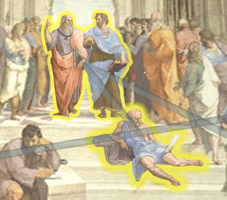
The Ahmanson Lab collaborated with The Vatican to render the Raphael Rooms, which contain multiple High Renaissance frescoes. The 16th century art historian Vasari compared figures across the room, creating a 3D narrative that would move between walls and the ceiling. A interdisciplinary team made a novel annotation interface for this— lines that criss-cross and entangle this space.
Three years of practical, critical, and hands-on workshops out of the makerspace at the Ahmanson Lab From 2019 to 2022, I taught a series of workshops at USC. I iterated on a workshop format for teaching both practical technical skills and critical thinking, adaptable to novel and emerging technologies across artificial intelligence, internet of things, rapid manufacturing, and augmented and virtual reality. The links above refer to event pages with descriptions of these workshops.
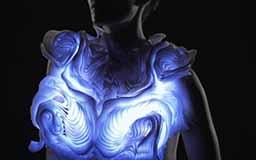
Bodyscape is a 3D printed fashion piece containing wearable technology by Behnaz Farahi. It was exhibited internationally (like at Ars!) and locally. I contributed by writing generative art patterns of light that respond to the model's gait. For other pieces I worked on maintenance code, bluetooth communications, and safety engineering.
Airbending 2015
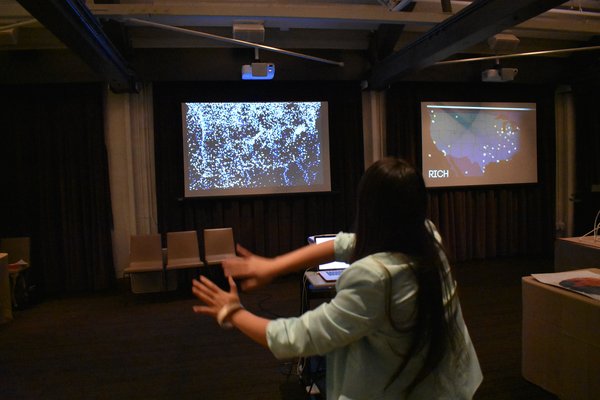
My first generative art piece! Airbending was an installation piece displaying a particle swarm controlled by a viewer’s arm movements.
Corpus Callosum was an engineering student organization named after the part of the brain that bridges both hemispheres-- like so, it encourages technology and arts projects. As technical director, I oversaw the growth of the org to over 100 participants and the org used systems that we put in place for over 10 years.